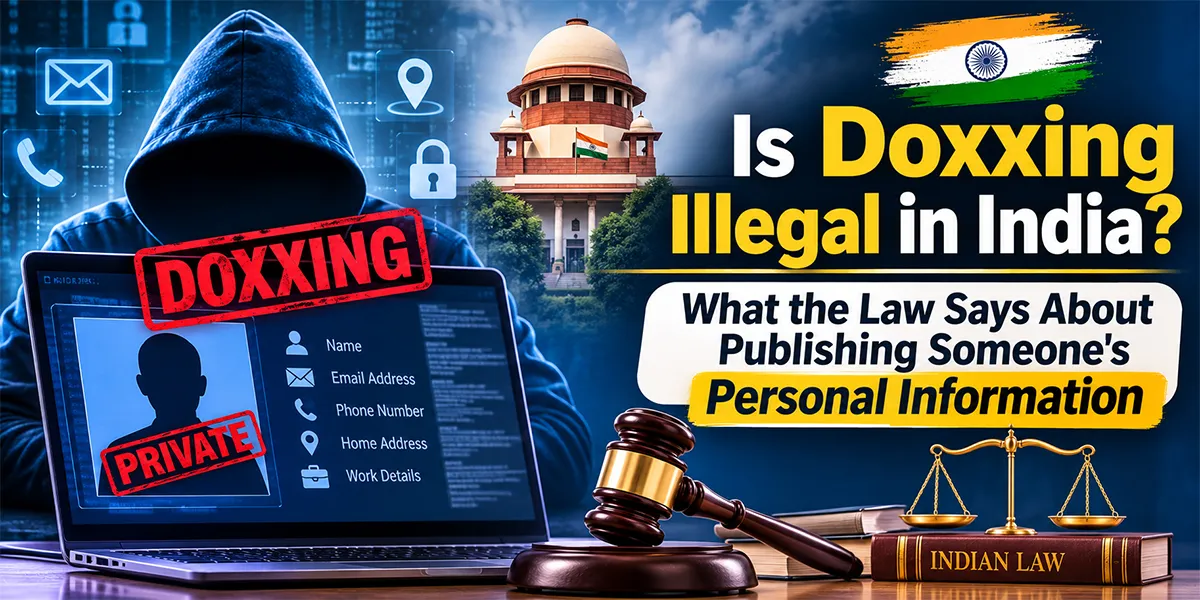
Thanks to social media, sharing information with others is very easy. This means you can easily share information from photos, phone numbers, work details, or personal conversations with thousands of people within minutes. Unfortunately, this has led to new invasions of privacy. Doxxing involves gathering and sharing personal information about an individual online without their permission. This can cause embarrassment or a threat.
Imagine you get into an argument online and someone decides to publish your home address, mobile number and work details. This could leave you with unwanted messages and calls from strangers.
This makes you wonder whether doxxing is illegal in India and whether someone can get into trouble for it.
Whilst there is no specific crime of doxxing under Indian law, there are several laws which can apply to the situation if someone publishes another person’s personal information.
What is Doxxing?
Doxxing (sometimes spelled doxing) is when someone finds out personal or identifying information about another person and shares it without their consent. This tends to happen online and can cause the victim to be harassed or intimidated.
Examples of this include:
- Publishing personal information such as a home address or mobile number.
- Publishing personal photos, conversations or emails.
- Publishing identity details such as Aadhaar, PAN or other identity documents.
- Publishing workplace details or family details.
- Publishing personal information to cause others to threaten or harass a person.
Sometimes people doxx others due to personal arguments, revenge or disagreements. Other times it is done to intimidate those who have posted opinions on sensitive topics.
However, it is important to consider that not every publication of personal information is doxxing or a crime. For example, journalism or genuine stories in the public interest.
Is Doxxing Illegal in India?
Whilst there are no specific laws regarding doxxing in India, there are several laws that can apply depending on the situation.
If someone publishes intimate photos, fraudulently uses another person’s identity or publishes threatening information, they may fall under certain provisions of the law.
The key thing to note is that just publishing personal information does not automatically mean a crime has been committed. The required elements of one of the provisions must be proved.
What Laws Apply to Doxxing in India?
There are many laws that can protect against digital crimes. Below are some that apply.
1. Information Technology Act, 2000
The Information Technology Act sets out many cybercrimes and digital crimes. Certain provisions may apply if the doxxing involves identity theft, intimate images or unauthorised sharing.
Section 66C – Identity Theft
This section covers the fraudulent or dishonest use of another person’s electronic signature, password or other unique identification feature.
For example, if someone steals another person’s login details and uses them dishonestly.
The punishment is imprisonment of up to 3 years and a fine of up to ₹1 lakh.
Section 66E – Violation of Privacy
This section covers capturing, publishing or transmitting images of a person’s private areas without their consent.
For example, if someone shares your intimate photos online without your consent.
The punishment is imprisonment of up to 3 years, or a fine of up to ₹2 lakh, or both.
Section 72A – Disclosure of Information in Breach of Lawful Contract
This section covers the unauthorised disclosure of personal information obtained whilst providing services under a lawful contract, where the information is disclosed without consent or in breach of the contract, with the intention to cause, or knowing that it is likely to cause, wrongful gain or wrongful loss.
For example, if an employee or service provider unlawfully discloses customers’ personal information obtained from them under a contract.
2. Bharatiya Nyaya Sanhita, 2023
The Bharatiya Nyaya Sanhita replaced the Indian Penal Code on 1st July 2024. Although there is no specific crime of doxxing, some sections may apply if publishing the personal information also involves threats, stalking or damage to reputation.
Section 351 – Criminal Intimidation
If someone publishes another person’s address or contact details and threatens them, this may fall under Section 351.
For example, if someone publishes your home address and threatens you or your family.
Section 78 – Stalking
This section covers stalking behaviour such as persistently following or contacting a woman when she has clearly shown she is not interested. It also covers monitoring her use of the internet, emails or other electronic communication.
If the doxxing amounts to stalking behaviour, then this section may apply.
Section 356 – Defamation
If someone publishes personal information alongside false accusations to damage another person’s reputation, this could also fall under criminal defamation.
However, simply publishing someone’s address or telephone number does not automatically amount to defamation.
3. Digital Personal Data Protection Act, 2023
The Digital Personal Data Protection Act, 2023 is an important piece of legislation regarding personal data in India.
It sets out a framework for processing digital personal data. This includes things like names, contact numbers, addresses and identity records. However, it is being brought into force in phases.
The core provisions (Sections 3–17) will not come into effect until May 2027, as per the commencement notification published in November 2025.
So currently, as of November 2026, these provisions have not yet come into effect. Therefore, it would be incorrect to say that all situations of unwanted information being published online will fall under the DPDP Act.
Right to Privacy
The issue of doxxing relates to your fundamental right to privacy.
In the landmark case of Justice K.S. Puttaswamy (Retd.) v. Union of India (2017), a nine-judge bench unanimously held that privacy is a fundamental right, protected as an intrinsic part of the right to life and personal liberty under Article 21 and as a part of the freedoms guaranteed by Part III of the Constitution.
The judgment confirmed that privacy is intrinsically linked to our dignity, freedom and autonomy.
This is important when considering digital privacy, as personal information can be collected, stored and shared without our knowledge.
Whilst this does not create a crime of doxxing, it does provide a strong constitutional basis to protect you against unlawful invasion of your privacy.
What Can You Do If You Have Been Doxxed in India?
If you have had your personal information published online, you can take the following steps.
- Collect Evidence: Take screenshots of the posts, save the relevant links, note the date and time and save the messages. Do not delete any important evidence.
- Report: File a complaint on the Government’s National Cyber Crime Reporting Portal or at your local police station or cybercrime police station.
- Request Removal: Report the content to the relevant social media platform or website. Explain how the publication has impacted your privacy and safety.
- Speak to a Lawyer: Depending on your situation, a lawyer can help you determine which provisions apply and whether you can file a criminal complaint, or seek compensation or an injunction.
It is important to report quickly if the information published puts you in immediate danger.
Conclusion
Overall, doxxing is a growing issue in India. Whilst there is no specific crime of doxxing, there are several provisions that can be applied. These include the Information Technology Act, 2000 and the Bharatiya Nyaya Sanhita, 2023. In addition, the right to privacy and the new data protection framework strengthen the discussion around personal information.
For law students, it is an interesting example of how our current laws need to adapt to new digital trends. It also raises an important question around the extent of our freedom of expression.
Whilst we have a fundamental right to freedom of expression, we do not have the right to publish someone else’s private life, threaten them or misuse their identity.